


Suggestions
Share
Journal Information
Vol. 44. Issue 10.
Pages 657-658 (October 2025)
Vol. 44. Issue 10.
Pages 657-658 (October 2025)
Image in Cardiology
Full text access
A narrow path
Um trajeto estreito
Visits
1464
Rodrigo Silvaa,
Corresponding author
rjpintosilva@gmail.com

Corresponding author.
, Sofia Nogueira-Fernandesa, Carina Arantesa, João Macielb, Vítor Hugo Pereiraa,c, Catarina Vieiraa, Sérgia Rochaa
a Serviço de Cardiologia do Hospital de Braga, Braga, Portugal
b Serviço de Cirurgia Cardiotorácica do Centro Hospitalar de São João, Porto, Portugal
c Escola de Medicina da Universidade do Minho, Braga, Portugal
This item has received
Article information
Full Text
Bibliography
Download PDF
Statistics
Figures (2)
Additional material (1)
Full Text

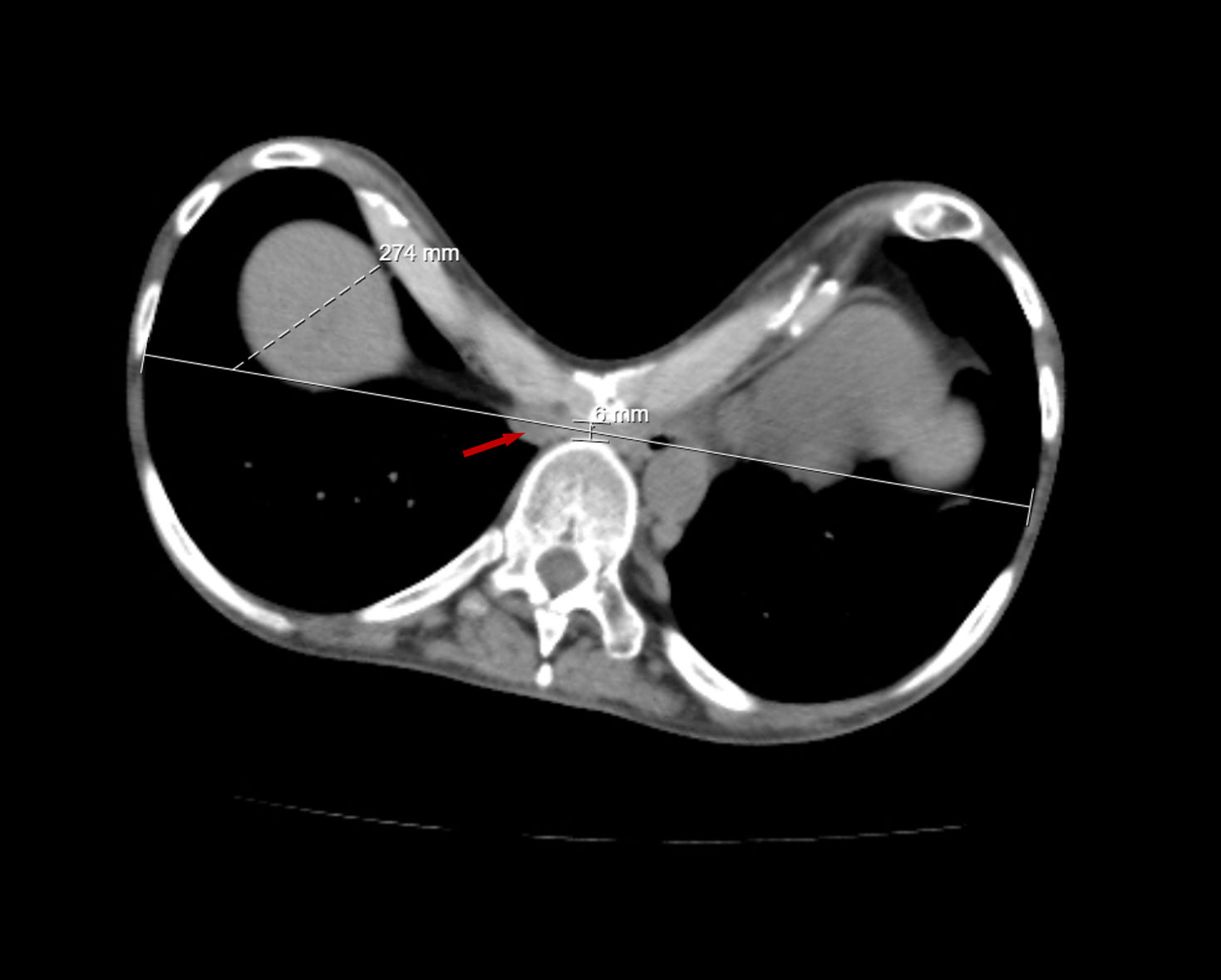
A 35-year-old man was sent to the Cardiology consult due to recurrent syncope after orthostatism preceded by prodromal symptoms. His syncopal response to orthostatism was so significant and so fast that he resorted to wheelchair ambulation. Additionally, the patient also reported episodes of syncope while lying down. Physical examination revealed the presence of an exuberant pectus excavatum. He was admitted to the Cardiology Department for evaluation. The initial cardiac study did not reveal significant findings: the 12-lead electrocardiogram presented an incomplete right bundle branch block, electrocardiographic monitoring showed rare supraventricular ectopy, and the transthoracic echocardiogram presented no relevant findings. A computed tomography scan was performed which showed severe pectus excavatum (Figure 1), with the lower sternum distancing 6 mm from the vertebral column, compressing the inferior vena cava (arrow). This resulted in a Haller index (a pectus index obtained from dividing the transverse diameter of the chest by the anterior–posterior diameter) of 46, far greater than the 3.25 cut-off to consider corrective surgery.1 A cardiac magnetic resonance imaging was then performed, revealing severe inferior vena cava compression in decubitus position (supplemental video).

Figure 1.

A computed tomography scan axial slice revealing a severe case of pectus excavatum with an antero-posterior diameter of 6 mm and inferior vena cava compression (arrow).

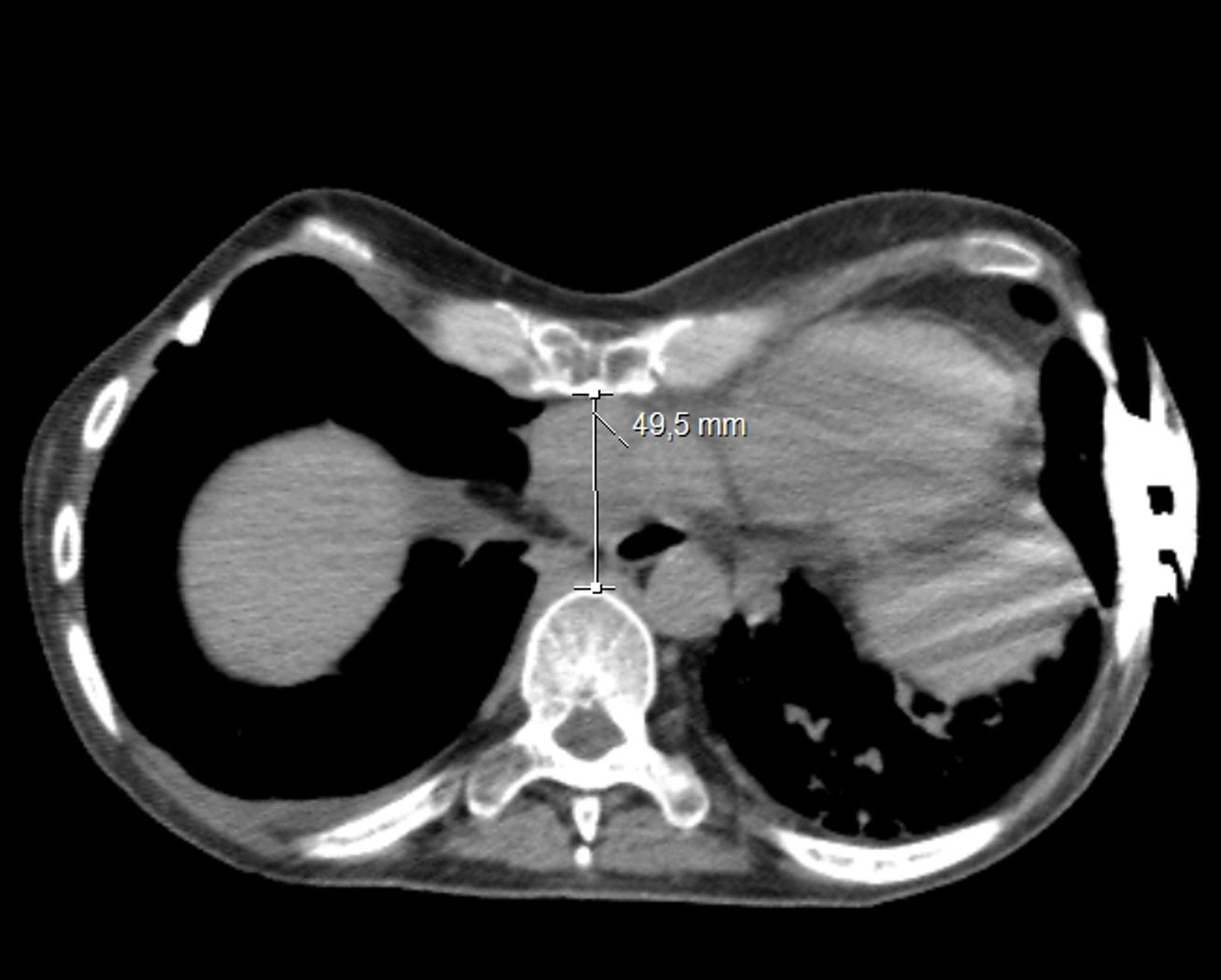
The patient was referred for thoracic surgery and underwent a Nuss procedure, minimally invasive surgery to correct this thoracic deformity using intrathoracic bars.2 The patient did not experience any relevant complications from this, was syncope free during the follow-up and was able to walk once again. The chest radiograph and CT scan in follow-up revealed the excellent outcome of the surgery (Figure 2) with inferior vena cava decompression.

Figure 2.

A computed tomography scan axial slice after the Nuss procedure showing the post-operative outcome with an antero-posterior diameter of 49.5 mm.

There are only a handful of published cases of pectus excavatum with inferior vena cava compression, with varying symptoms, such as syncopal episodes,3 lower extremity edema4 and pulsus paradoxus.5 To the best of our knowledge, we present the case with the most severe thoracic deformity causing disabling syncope in orthostatism, with a good functional outcome after surgical intervention.

Conflicts of interest

The authors have no conflicts of interest to declare.

Appendix B
Supplementary data

The following are the supplementary data to this article:

(0.59MB)

A cardiac magnetic resonance axial cine showing inferior vena cava compression.

References
[1]
J.A. Haller Jr., S.S. Kramer, S.A. Lietman.
Use of CT scans in selection of patients for pectus excavatum surgery: a preliminary report.
J Pediatr Surg, 22 (1987), pp. 904-906
[2]
C.S. Velazco, R. Arsanjani, D.E. Jaroszewski.
Nuss procedure in the adult population for correction of pectus excavatum.
Semin Pediatr Surg, 27 (2018), pp. 161-169
[3]
J.A. White, N.M. Fine, Y. Shargall.
Pectus excavatum with compression of the inferior vena cava: a rare cause of recurrent syncope.
Circulation, 120 (2009), pp. 1722-1724
[4]
G.J. Iannucci, T.C. Slesnick, B. Kogon, et al.
Lower extremity edema in a child due to pectus excavatum.
Ann Thorac Surg, 99 (2015), pp. e29-e30
[5]
K. Yalamanchili, W. Summer, V. Valentine.
Pectus excavatum with inspiratory inferior vena cava compression: a new presentation of pulsus paradoxus.
Am J Med Sci, 329 (2005), pp. 45-47
Download PDF
Idiomas
Revista Portuguesa de Cardiologia (English edition)
Article options
Tools
Supplemental materials
en pt

Are you a health professional able to prescribe or dispense drugs?

Você é um profissional de saúde habilitado a prescrever ou dispensar medicamentos

By checking that you are a health professional, you are stating that you are aware and accept that the Portuguese Journal of Cardiology (RPC) is the Data Controller that processes the personal information of users of its website, with its registered office at Campo Grande, n.º 28, 13.º, 1700-093 Lisbon, telephone 217 970 685 and 217 817 630, fax 217 931 095, and email revista@spc.pt. I declare for all purposes that the information provided herein is accurate and correct.
