

Journal Information
Vol. 44. Issue 12.
Pages 747-749 (December 2025)
Vol. 44. Issue 12.
Pages 747-749 (December 2025)
Image in Cardiology
Full text access
Successful removal of right atrial thrombus using a large-bore aspiration system
Remoção bem-sucedida de trombo auricular direito utilizando sistema de aspiração percutâneo de grande calibre
Visits
337
Margarida G. Figueiredoa,
Corresponding author
, Mariana Saraivab, Melanie Ferreirac, Luís Almeida Moraisa
a Cardiology Department, Hospital de Santa Marta, ULS S. José, Lisboa, Portugal
b Cardiology Department, Hospital de Santo André, ULS Região Leiria, Leiria, Portugal
c Internal Medicine Department, ULS S. José, Lisboa, Portugal
This item has received
Article information
Full Text
Bibliography
Download PDF
Statistics
Figures (2)
Additional material (3)
Full Text

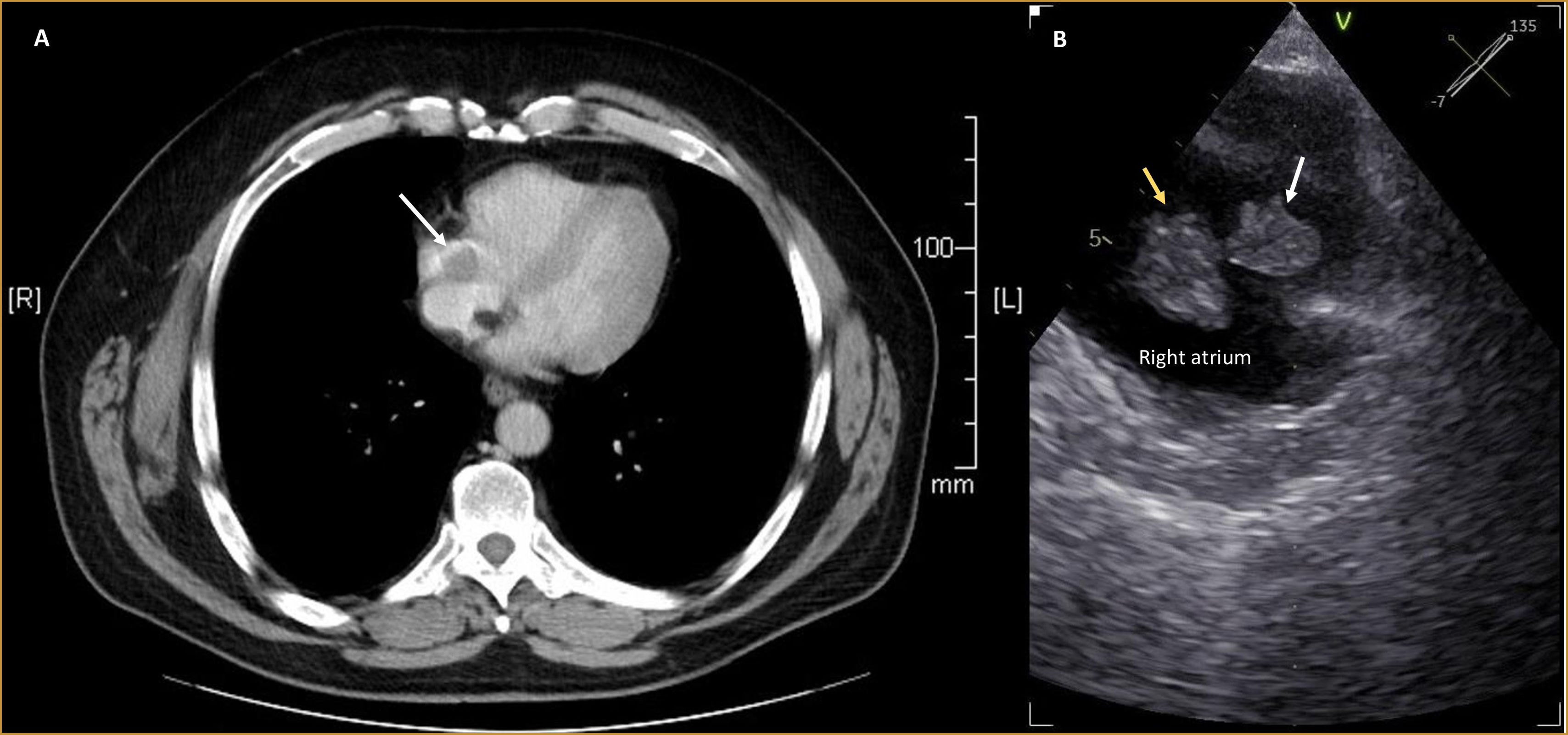
We present the case of a 60-year-old asymptomatic male patient with a medical history of rectal adenocarcinoma under chemotherapy, with a totally implantable venous access port (TIVAP). A staging computed tomography scan showed an intracardiac mass (Figure 1, Panel A) and the transesophageal echocardiography confirmed the presence of two extremely mobile masses in the right atrium, adherent to the tip of the TIVAP, the larger of the two measuring 20 mm × 20 mm (Figure 1, Panel B). Due to the patient's high risk of bleeding, anticoagulation with enoxaparin was started and, after one week, the thrombus was re-evaluated; it maintained the same dimensions and mobile appearance. After discussion in the heart team, we decided to perform a mechanical thrombectomy, with extracorporeal membrane oxygenation prepared, if needed.

Figure 1.

Panel A: A thoracic CT scan revealing an intracardiac mass in the right atrium (white arrow). Panel B: Transesophageal echocardiography confirming the presence of two mobile masses suggestive of thrombus in the right atrium (yellow arrow the larger mass, white arrow the smaller one).

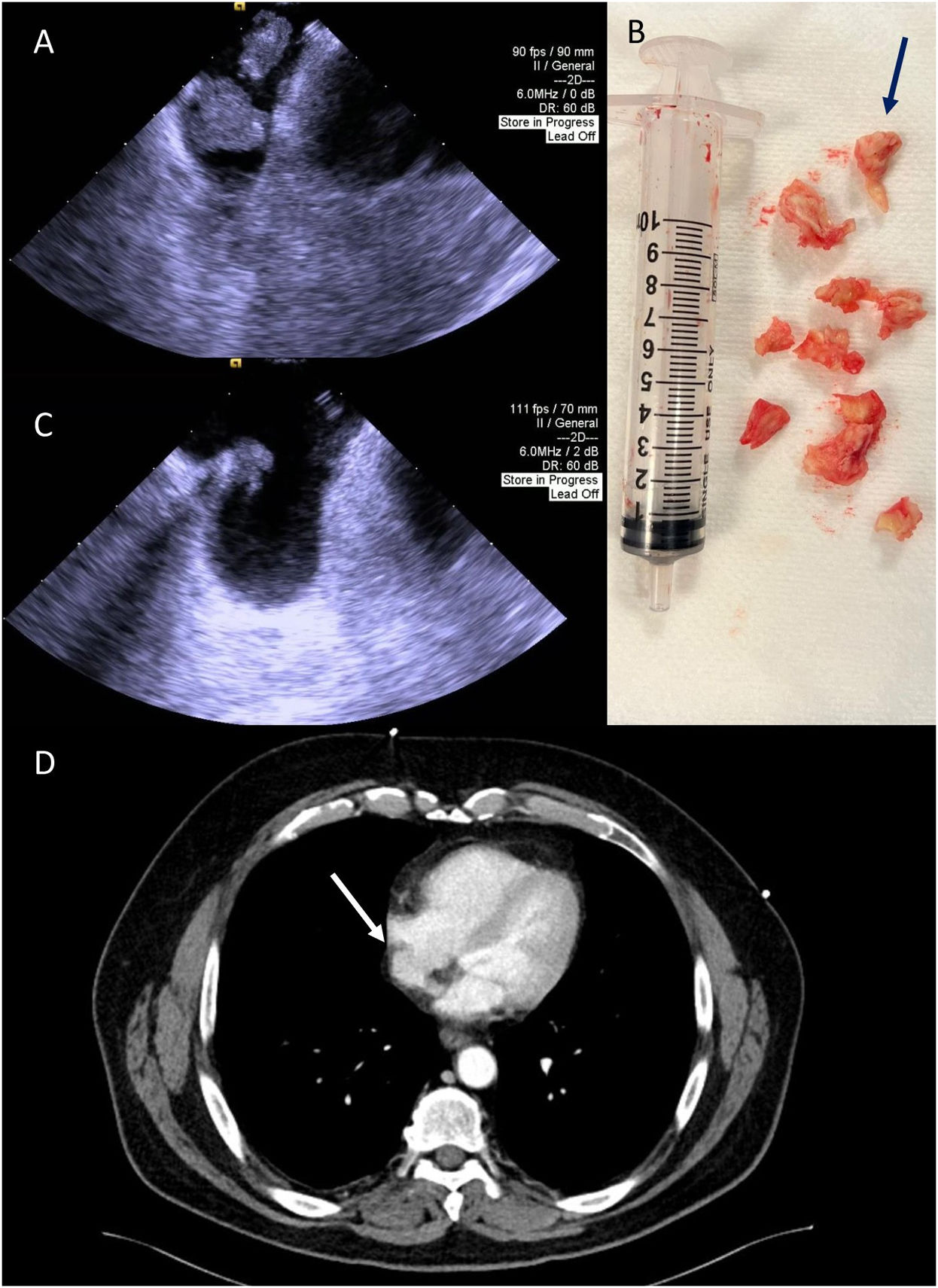
Intracardiac echocardiography (ICE) was selected to guide mechanical aspiration with the FlowTriever 24Fr System,1 as it obviates the need for transesophageal echocardiography, which may carry sedation-related hemodynamic risks.2 It was possible to remove the shorter mass and almost the totality of the larger mass, that was severely attached to the terminal part of the TIVAP (Figure 2, Panels A and B and Supplementary Videos 1–3). At the end of the procedure, a pulmonary angiography did not reveal significant perfusion defects or pulmonary hypertension. ICE showed residual thrombus attached to the terminal part of TIVAP, confirmed by CT angiography (Figure 2, Panels C and D), which also revealed fragmental thrombus in the lower lobe of the left pulmonary artery. Histological analyses confirmed the presence of chronic organized thrombus. The post-procedure course was free of complications, and the patient was discharged after four days. Anticoagulation was maintained.

Figure 2.

Panel A: Intracardiac echocardiography used to guide mechanical aspiration showing the two masses. Panel B: The fragmented thrombus that was aspirated from the right atrium – predominantly white, compatible with the presence of fibrin (blue arrow). Panel C: Post-procedural intracardiac echocardiography image demonstrating a residual thrombus. Panel D: Thoracic CT angiography performed after the procedure showing small residual thrombus in the right atrium (white arrow).

There is a lack of consensus regarding the optimal management of right heart thrombus, especially without concurrent pulmonary embolism.3–5 Our case demonstrates that in patients considered to be at high surgical risk, large-bore aspiration thrombectomy, when guided by appropriate imaging modalities, can be technically feasible and generally safe. However, it may still be associated with potential complications, including thrombus fragmentation and embolization and incomplete thrombectomy, as demonstrated in this clinical case.

Ethical approval

Our institution does not require ethical approval for reporting individual cases or case series.

Conflicts of interest

The authors have no conflicts of interest to declare.

Appendix B
Supplementary data

The following are the supplementary data to this article:

(0.62MB)

Supplementary Video 1 ICE showing the two thrombus in the right atrium at the beginning of the procedure.

(0.5MB)

Supplementary Video 2 ICE enabled visualization of the FlowTriever catheter in the right atrium and facilitated its guidance toward the thrombus.

(0.42MB)

Supplementary Video 3 ICE captured the moment of aspiration of the larger thrombus attached to the TIVAP tip.

References
[1]
S. Finocchiaro, M.S. Mauro, C. Rochira, et al.
Percutaneous interventions for pulmonary embolism.
EuroIntervention, 20 (2024), pp. e408-e424
[2]
A. Khosla, H. Mojibian, R. Assi, et al.
Right heart thrombi (RHT) and clot in transit with concomitant PE management: approach and considerations.
Pulm Circ, 12 (2022),
[3]
S.V. Konstantinides, G. Meyer, C. Becattini, et al.
2019 ESC Guidelines for the diagnosis and management of acute pulmonary embolism developed in collaboration with the European Respiratory Society (ERS).
Eur Heart J, 41 (2020), pp. 543-603
[4]
B. Rivera-Lebron, M. McDaniel, K. Ahrar, et al.
Diagnosis treatment and follow up of acute pulmonary embolism: consensus practice from the PERT consortium.
Clin Appl Thromb Hemost, 25 (2019), pp. 1-16
[5]
Z. Rozenbaum, E. Gnall.
Percutaneous cardiac chambers and pulmonary artery aspiration.
Curr Cardiol Rep, 25 (2023), pp. 681-691
Download PDF
Idiomas
Revista Portuguesa de Cardiologia (English edition)
Article options
Tools
Supplemental materials
en pt

Are you a health professional able to prescribe or dispense drugs?

Você é um profissional de saúde habilitado a prescrever ou dispensar medicamentos

By checking that you are a health professional, you are stating that you are aware and accept that the Portuguese Journal of Cardiology (RPC) is the Data Controller that processes the personal information of users of its website, with its registered office at Campo Grande, n.º 28, 13.º, 1700-093 Lisbon, telephone 217 970 685 and 217 817 630, fax 217 931 095, and email revista@spc.pt. I declare for all purposes that the information provided herein is accurate and correct.
